
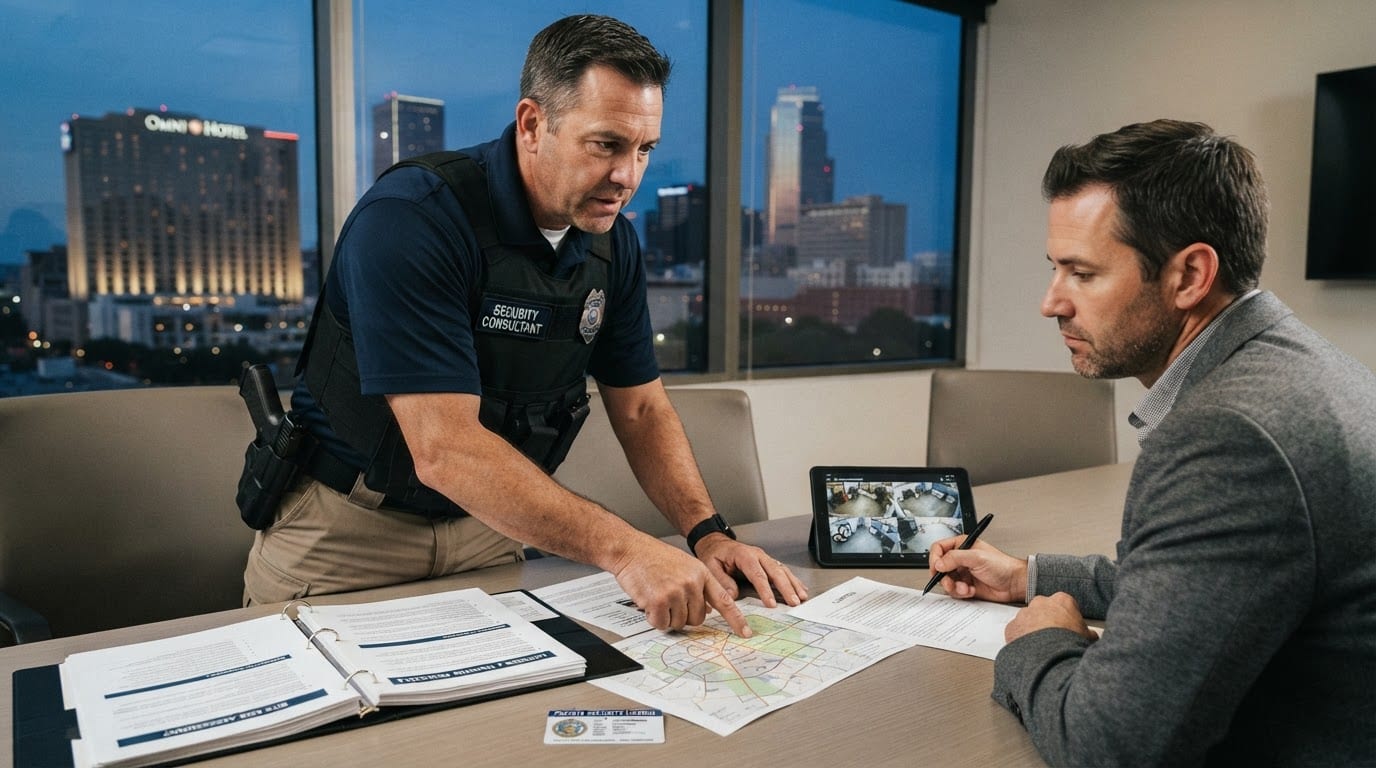
Few security decisions carry as much weight as putting an armed officer on your property. The guard becomes the most visible representation of your business or community, and the provider’s hiring, training, and supervision practices determine whether that presence reduces risk or creates new liability. Many property managers and business owners begin the search with price and availability, then discover later that the officer lacked the right credentials or that the contract left them exposed after an incident.
Anyone evaluating armed security guard companies fort worth should treat the process as a due-diligence exercise rather than a purchase. The right provider should be able to show verifiable licensing, a documented approach to matching officers to the site, a training and supervision program on paper, and contract terms that allocate responsibility clearly. The sections below walk through each of those checkpoints in the order they should be reviewed.
Armed guard services in Texas operate under a state framework, and the requirements are more specific than many buyers expect. Reviewing that framework first narrows the field quickly, because a provider that cannot document its licensing trail should not advance to pricing discussions.
Start With the Licensing Trail Before Anything Else
Texas regulates private security under Chapter 1702 of the Occupations Code, and the Texas Department of Public Safety administers company licenses and individual commissions. Confirm that the firm holds a valid private security company license, and that each officer assigned to an armed post holds the commission level the state requires for armed work. In Texas, that distinction matters: commissioned officers carry a state-issued commission card, and armed duties require the specific level and firearm endorsement rather than a general guard card.
Do not rely on a certificate or PDF the provider sends. Search the DPS private security license lookup yourself, using the company’s exact registered name and license number, and confirm the status, expiration date, and any listed restrictions. Repeat the check for individual officers, particularly those who will be assigned to your site. Mismatched names, lapsed licenses, or entities operating under a different registered name are common warning signs.
Ask the provider how it verifies renewals and whether it tracks expired credentials across its staff. A strong answer includes a centralized roster, scheduled renewal reminders well before expiration, and a rule that an officer whose commission has lapsed is removed from armed duty immediately. Ask to see how that roster is maintained and who reviews it.
Match the Armed Post to the Actual Risk
An armed guard is not automatically the stronger option. A firearm changes the force profile of an incident, the liability exposure, and the type of response that is appropriate. In many settings, a visible unarmed officer who can observe, document, call police, and deter through presence provides more practical value than an armed officer who is positioned poorly or is not allowed to intervene in most situations.
Risk profiles vary considerably by property type. Retail stores often face shoplifting, cash-handling exposure, and after-hours break-ins, which may justify an armed presence during high-risk periods. Apartment communities usually present trespassing, vehicle break-ins, and disturbances, where patrols and an unarmed officer frequently fit better. Construction sites face theft of materials and equipment and unauthorized access after hours, where mobile patrol and camera coverage can cover more ground than a fixed post. Special events call for crowd management and access control, where visibility and communication matter more than firearms.
Before deciding, ask specific questions about the threat profile:
- How much cash is handled on site, and at what times?
- Which hours have the most unauthorized access attempts?
- Have there been prior incidents, and were any involved weapons?
- Does the site have a history of disputes that could escalate?
- Are police response times in the area typical, or are there known delays?
The answers should drive the decision, not the sense that armed coverage is simply more serious.
Stationary Posts Versus Patrol Coverage
A fixed post makes sense when a specific point must be controlled continuously. Lobby monitoring, access control at a gate or loading dock, and visitor screening at a secured building are typical examples. The officer’s value comes from being present at one location and from maintaining logs, visitor records, and clear escalation steps.
Scheduled or random patrols suit large or multi-site properties better. A mobile officer or patrol vehicle can check exterior perimeters, parking areas, and outbuildings at irregular intervals, which is harder for intruders to anticipate. Patrol logs with time-stamped checkpoints, or GPS-verified rounds where available, give the client documented proof of coverage. Many properties use a combination, with a fixed post during peak hours and patrols overnight.
Look at How Armed Officers Are Trained, Screened, and Supervised
Training requirements in Texas set a floor, not a standard of excellence. The state mandates minimum training hours for commissioned officers and a firearm qualification process that must be conducted with a DPS-certified instructor. Ask the provider for its total initial training hours, the firearm qualification schedule, and the recertification interval for both the commission and the weapon qualification. Many reputable firms exceed the state minimum, particularly for armed posts, and that additional training is worth asking about directly.
Screening should go beyond the state background check. Ask whether the provider conducts fingerprint-based criminal history checks, motor vehicle record reviews where driving is involved, employment verification, and drug testing, and whether it repeats those checks periodically after hire. Periodic reviews matter because an officer’s circumstances can change after the initial hire.
Supervision is where many programs fail in practice. Ask how often supervisors make unannounced site visits, what those visits include, and whether they are logged. Find out how guards check in during a shift, whether through radio, phone, or a software-based checkpoint system, and what happens when a check-in is missed. Clarify how incidents are escalated, including who receives notification, within what timeframe, and whether the client is notified directly.
Use-of-force policy is a central document. The provider should have a written policy that defines when force, including deadly force, may be used, the duty to retreat where applicable, documentation requirements after any use of force, and the reporting chain. Ask whether officers receive scenario-based training that tests judgment under pressure, not just marksmanship. Training that includes de-escalation, verbal commands, and decision-making under stress is a better indicator of discipline than range scores alone. Ask whether the firm references established frameworks, such as ASIS International guidance or documented OSHA workplace-violence considerations, when building its training program.
Read the Contract and Pricing Terms Closely
Armed guard pricing in the Dallas–Fort Worth market commonly runs from roughly $30 to $55 per hour for armed officers, depending on the post type, shift length, and the provider’s overhead. Patrol services and supervisory time are often billed separately. Prices outside this range warrant questions, since very low rates often indicate thin training budgets or reliance on uncommissioned staff.
Common billing structures include:
- Hourly rates, which differ for armed and unarmed officers and for supervisory staff.
- Minimum shift lengths, often four or eight hours, which can make short-duration events more expensive than expected.
- Overtime, typically billed at 1.5 times the base rate for hours beyond a defined threshold.
- Holiday surcharges, which can add significant cost during major holidays and certain city events.
Insurance deserves close attention. Request certificates showing general liability coverage and any other required limits, and confirm the client is named as an additional insured on the policy. Ask the provider to confirm that its coverage applies to armed operations specifically, since some policies carve out firearm-related incidents.
Review the indemnification clause carefully. It should clearly describe which party bears responsibility for claims arising from the officer’s actions, and it should not shift liability to the client for the provider’s own negligence. Cancellation terms should state notice periods and any early termination fees. Ask what happens when a guard calls out sick. A serious provider will specify a replacement timeline, usually within a few hours, and will say whether the replacement holds the same credentials and has been briefed on the site.
Post orders are the site-specific instructions that define duties, access rules, reporting requirements, and emergency procedures. The contract should state who writes and approves them, who owns them, and how they are updated. Clients should retain ownership of their site instructions and receive current copies. Without this, a change in provider can leave the property without usable documentation.
Compare Providers on Local Operations and Proof of Performance
Local operations affect response quality more than most proposals reveal. Ask how quickly the firm can fill a vacated post, what its backup staffing process looks like, and whether it has officers based in or near Fort Worth. Staff who live nearby are more likely to be available on short notice, and local staff familiarity with routes, neighborhoods, and municipal rules is useful in a city where weather and traffic patterns change the operating environment. Summer heat regularly exceeds 100°F, which affects outdoor posts, required breaks, and equipment, while severe thunderstorms and hail can disrupt patrol routes and exterior coverage.
Request references from clients with similar sites, and ask specific questions rather than general satisfaction questions. Useful questions include how incidents were documented and reported, how long it took the provider to respond when a problem arose, how supervisors handled a missed shift, and whether the officer’s reports were clear enough to support a police report or insurance claim.
Be cautious with broad "best of" rankings. Such lists rarely disclose how they were compiled, whether providers paid for placement, or how performance was measured. A buyer is better served by verifiable records: the state license status, documented training and use-of-force policies, insurance certificates, and references from comparable sites. Those documents reveal far more about how a provider will perform than a ranking does.
The strongest proposal is one that can be verified line by line. If a provider cannot produce licensing records, written policies, and named references within a reasonable time, that gap is itself the most useful finding in the comparison.