
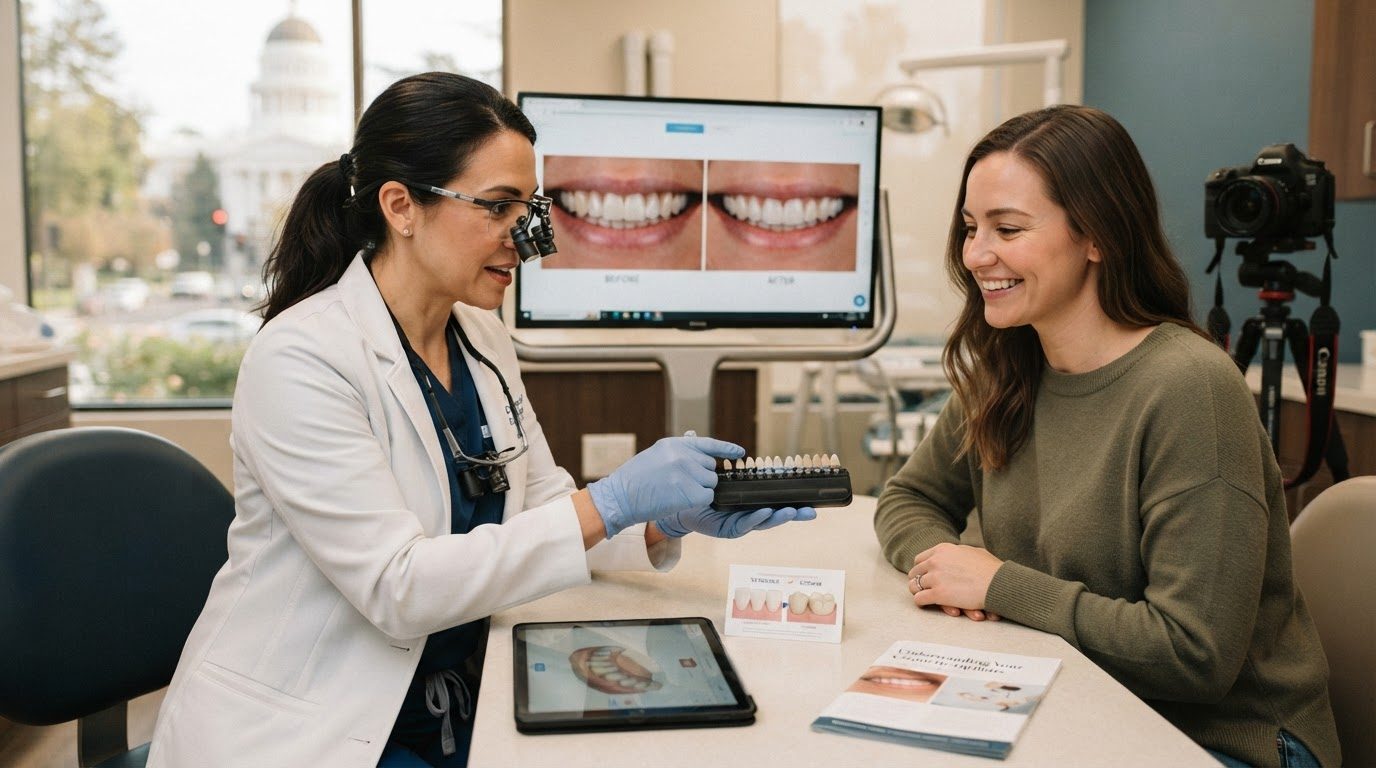
A smile can look uneven for reasons that whitening alone cannot fix: one darkened tooth, worn edges, small gaps, or proportions that do not match the rest of the face. Porcelain veneers address these concerns by changing the visible shape, color, and surface character of selected teeth.
For patients researching porcelain veneers, the important question is not simply whether the treatment can create a brighter smile. It is whether porcelain, preparation, bite protection, and the proposed design are appropriate for the condition of the teeth.
A careful cosmetic consultation should begin with oral health and end with a written plan. At Samuel Dental Care, Sacramento patients can discuss cosmetic goals alongside alternatives such as whitening, bonding, Invisalign, crowns, and restorative care rather than choosing a veneer by appearance alone.
What Porcelain Veneers Can Change—and What They Cannot
A porcelain veneer is a custom-made ceramic shell bonded to the visible front surface of a tooth. It can conceal:
- Persistent discoloration that does not respond adequately to whitening.
- Chips, small cracks, worn edges, or irregular contours.
- Minor spaces between teeth.
- Misshapen, undersized, or uneven teeth.
- Limited alignment concerns when the bite and tooth position are otherwise suitable.
Porcelain is valued for its translucency, which can reflect light in a way that resembles enamel. The result should not be an identical “perfect” smile copied from a template. A natural design considers facial proportions, gum display, smile line, neighboring teeth, speech, and the patient’s preferred shade and degree of symmetry.
Veneers are cosmetic restorations. They do not treat active decay, infection, advanced gum disease, or a severely weakened tooth. Those conditions should be diagnosed and managed first. A crown covers substantially more of a tooth and is generally selected when structural reinforcement and protection are more important than changing only the front surface.
Is This Treatment Appropriate for Your Teeth?
Evaluation typically includes:
- Enamel thickness and existing cracks or wear.
- Cavities, leaking fillings, and previous restorations.
- Gum inflammation, periodontal pockets, and recession.
- Tooth position, contact points, and bite forces.
- Grinding, clenching, and the depth of the overbite.
- The patient’s cosmetic priorities and tolerance for enamel preparation.
Healthy teeth and gums provide a more predictable foundation. Untreated inflammation or decay beneath a veneer can compromise the tooth and the restoration. Patients who grind or clench may need a custom night guard and a design that avoids excessive loading. A deep bite can also require bite modification or an alternative treatment plan.
Traditional veneers usually require conservative enamel reduction so the ceramic has room to achieve the planned contour without making teeth look bulky. Minimal-prep and no-prep approaches remove less enamel, but they are not universally appropriate. They may work when teeth are already favorably positioned and the desired change is modest; they are not a way to avoid every biological limitation.
Alternatives may be more conservative:
- Whitening for a color-only concern.
- Composite bonding for a small chip or limited reshaping.
- Invisalign for tooth movement and more significant alignment issues.
- Crowns or restorative treatment for structurally compromised teeth.
Designing and Placing Your Custom Veneers
The consultation should establish what the patient wants to change and what should remain natural. Shade, tooth length, width-to-height ratios, incisal edges, facial symmetry, gum line, and the relationship to adjacent teeth all influence the design.
The clinical record may include photographs, radiographs when indicated, digital scans or conventional impressions, and bite records. A mock-up or provisional design can help evaluate tooth proportions and phonetics before final fabrication. The goal is to preview the direction of treatment—not to promise that a digital image will exactly reproduce the final result.
Preparation varies by tooth. The dentist may remove a small amount of enamel from the facial surface and, where needed, the edge or contact areas. Local anesthetic is available when appropriate. Laboratory-made porcelain restorations commonly require more than one visit:
- Teeth are evaluated and prepared, and records are sent to the laboratory.
- Temporary veneers may protect prepared teeth and provide an opportunity to assess shape and comfort.
- At the delivery visit, each veneer is tried in and checked for shade, margins, contacts, and fit.
- After the patient and dentist approve the design, the tooth surfaces are cleaned and conditioned, the veneer is bonded with resin cement, and the bite is evaluated.
- Minor adjustments may be made to contacts or occlusion.
Temporary sensitivity, gum tenderness, or awareness of the bite can occur briefly. Most patients resume normal activities promptly, although eating instructions may vary while anesthesia is wearing off or the cement reaches its intended strength.
Porcelain Veneers Compared with Other Cosmetic Options
Porcelain versus composite veneers
Porcelain generally offers greater stain resistance, more lifelike translucency, and longer service than composite resin. It is fabricated in a laboratory and bonded to the tooth, so treatment often takes multiple appointments. If porcelain chips or fractures, repair may be limited and replacement is often required.
Composite veneers can frequently be shaped directly in one visit. They are usually more affordable and easier to repair, making them practical for a small correction, a trial design, or a shorter timeline. However, composite is more susceptible to staining, surface wear, and loss of polish. Actual fees depend on the number of teeth, laboratory selection, preparation, and case complexity.
Veneers versus whitening or Invisalign
Whitening changes tooth color but not length, width, shape, or position. It may be the most conservative first step when discoloration is the only concern. Veneers can change color and form, but they require a long-term commitment.
Invisalign and other clear-aligner systems move teeth through controlled orthodontic forces. They may better address spacing, crowding, or functional alignment. A combined sequence—alignment followed by limited bonding or veneers—can sometimes preserve more enamel than using veneers to camouflage tooth position.
Veneers versus crowns
A veneer covers primarily the front surface. A crown provides full or near-full coverage and is designed to restore a tooth that has lost substantial structure through decay, fracture, a large filling, or trauma. Using a veneer on a tooth that needs structural protection can produce an inappropriate treatment plan; conversely, placing a crown solely for a minor cosmetic issue is generally more invasive.
Longevity, Maintenance, and the Long-Term Commitment
Porcelain itself is generally resistant to staining, but bonding margins and neighboring natural teeth can discolor. Whitening does not change the shade of existing porcelain, so any planned bleaching should usually be completed before final shade selection.
Care includes:
- Brushing twice daily with a soft-bristled brush and non-abrasive fluoride toothpaste.
- Flossing or cleaning between teeth every day.
- Professional cleanings and routine examinations.
- Avoiding ice chewing, nail biting, package opening, and biting hard objects.
- Using a sports mouthguard for activities with facial-impact risk.
- Wearing a dentist-prescribed night guard when grinding or clenching is present.
Porcelain veneers commonly last many years with proper care; published clinical estimates often fall around 10 to 15 years, although outcomes vary. Chipping, debonding, gum changes, decay at an untreated margin, and normal wear can require repair or replacement. Traditional preparation is generally irreversible because enamel has been altered. Even minimal-prep treatment should be considered carefully rather than assumed to be reversible.
Cost, Insurance, and Planning Treatment in Sacramento
Veneer fees vary substantially. Major cost factors include:
- The number of teeth treated.
- Ceramic type and laboratory craftsmanship.
- Preparation complexity and temporary restorations.
- Replacement of old fillings or existing cosmetic work.
- Related periodontal, restorative, whitening, or orthodontic treatment.
In the United States, a broad planning range is often approximately $1,000 to $2,500 per porcelain veneer, but local fees may fall outside that range. A consultation is necessary for an accurate estimate. Cosmetic veneers are commonly excluded from dental insurance because appearance is the primary purpose. A crown, periodontal procedure, or other medically necessary treatment may be assessed under different benefit rules, depending on the plan.
Before accepting treatment, request a written breakdown showing the teeth included, preparation, temporaries, laboratory fees, follow-up care, replacement policy, sequencing, and payment expectations. Ask whether financing options are available; Samuel Dental Care’s published patient information identifies CareCredit and Cherry as payment-plan options, subject to approval and current terms.
Sacramento patients should also consider scheduling around work and travel, particularly when temporary restorations are involved. The most useful consultation is not a sales presentation. It is a diagnostic conversation about enamel, gums, bite forces, design goals, alternatives, and the likely maintenance commitment. A qualified dentist can then determine whether porcelain veneers are the right solution—or whether a less invasive treatment will produce the better long-term result.